Lei è apparsa / Ukazała się / She appeared: Il custode della verità / The Custodian of Truth / Strażnik Prawdy – la Dissertazione per il Dottorato, Pontificia Università Gregoriana / doctoral dissertation, Pontifical Gregorian University / rozprawa doktorska, Papieski Uniwersytet Gregoriański
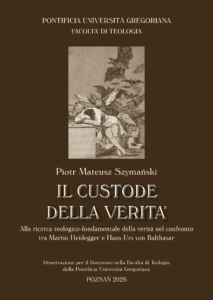
First Edition Year of publication: 2026
Binding: soft Volume: 350 pages Format: 170×240 mm Italian Category: Philosophy / Theology
Publisher Scientific Publisher Kontekst
Doctoral dissertation
Dissertazione per il Dottorato nella Facoltà di Teologia della Pontificia Università Gregoriana
|
Piotr Mateusz Szymański
Il custode della verità Alla ricerca teologico-fondamentale della verità nel confronto tra Martin Heidegger e Hans Urs von Balthasar The Custodian of Truth Fundamental-Theological Quest for Truth in the Confrontation between Martin Heidegger and Hans Urs von Balthasar Strażnik prawdy Teologiczno-fundamentalne poszukiwanie prawdy w dialogu między Martinem Heideggerem a Hansem Ursem von Balthasarem
Wydanie pierwsze
Rok wydania 2026
Oprawa miękka
Objętość 350 stron
Format 170 x 240 mm
Język włoski
Kategoria Filozofia / Teologia
Wydawca Wydawnictwo Naukowe Kontekst
Rozprawa doktorska
ISBN 978-83-68332-26-1 |
Książka proponuje głęboką refleksję teologiczną nad naturą prawdy, ukazując ukryty dialog między dwoma wielkimi myślicielami XX wieku: niemieckim filozofem Martinem Heideggerem oraz szwajcarskim teologiem Hansem Ursem von Balthasarem.
Autor przyjmuje za punkt wyjścia strukturę pierwszego tomu „Teologiki” Balthasara pt.: „Prawda świata” i w tym świetle analizuje pojęcie prawdy w jej czterech kluczowych wymiarach: bycie, wolność, tajemnica i uczestnictwo. Balthasar, idąc śladami myśli Heideggera, uznaje klasyczną definicję prawdy – jako zgodność między intelektem a rzeczą – za niewystarczającą i nie sięgającą jej istoty. Obaj definiują prawdę jako dynamiczne, ontologiczne wydarzenie odsłaniania się bytu – jako ἀλήθεια (alētheia), „nieskrytość”, „Erschlossenheit”.
U Heideggera prawda jawi się jako temporalne, dramatyczne wydarzenie, nierozerwalnie związane ze skończonością ludzkiego „Dasein” i z wycofującym się charakterem samego Bycia („Sein”). Człowiek zostaje powołany do roli „pasterza bytu” – ma wsłuchiwać się w jego mowę w myśleniu i w poezji.
Balthasar, przyjmując epifaniczną i dynamiczną naturę prawdy, wzbogaca grecką alētheia o biblijną kategorię ’ĕmet – wierność, wiarygodność, która odsyła do trwałego fundamentu, na którym można się oprzeć. Prawda stworzona, choć naznaczona skończonością, uczestniczy w nieskończoności Boga i objawia się jako piękno i chwała. Swoje ostateczne dopełnienie znajduje w chrześcijańskim Objawieniu, w którym byt odsłania swe najgłębsze fundamenty w trynitarnej miłości Boga.
W tym świetle teologia fundamentalna odkrywa swoją istotną misję: staje się „strażnikiem prawdy” – ma czuwać nad wiarygodnością Objawienia Bożego w Chrystusie, broniąc prawdy z jednej strony przed racjonalistycznym redukcjonizmem, z drugiej przed idealistycznym irracjonalizmem. Nade wszystko teologia fundamentalna musi uczyć postawy kontemplacyjnej pokory, otwartej miłości i adoracji wobec tajemnicy bytu skończonego i nieskończonego.
Książka jest zaproszeniem do ponownego, twórczego zmierzenia się z pytaniem o prawdę, które w epoce kryzysu wiarygodności i kultury post-prawdy, pozostaje jednym z najbardziej palących wyzwań zarówno dla filozofii, jak i dla teologii.
The book offers a profound theological reflection on the nature of truth, revealing an implicit dialogue between two towering thinkers of the 20th century: the German philosopher Martin Heidegger and the Swiss theologian Hans Urs von Balthasar.
Taking as its point of departure the structure of the first volume of Balthasar’s Theo-Logic, entitled The Truth of the World, the author examines the concept of truth across its four key dimensions: being, freedom, mystery, and participation. Following in the footsteps of Heidegger’s thought, Balthasar regards the classical definition of truth—as mere correspondence between intellect and thing—as inadequate and failing to reach its essence. Both thinkers define truth as a dynamic, ontological event of the unconcealment of being—as ἀλήθεια (alētheia), “unconcealment”, “Erschlossenheit”.
For Heidegger, truth appears as a temporal, dramatic event inextricably linked to the finitude of human Dasein and to the withdrawing character of Being (“Sein”) itself. Humanity is called to the role of “shepherd of Being”, attentively listening to its call through meditative thinking and poetry.
Balthasar, while embracing the epiphanic and dynamic nature of truth, enriches the Greek alētheia with the biblical category of ’ĕmet—faithfulness, reliability, trustworthiness—which points to a stable foundation on which one can rely. Created truth, though marked by finitude, participates in God’s infinity and manifests itself as beauty and glory. It finds its ultimate fulfillment in Christian Revelation, where being discloses its deepest foundations in the triune love of God.
In this light, fundamental theology rediscovers its essential mission: to become the “custodian of truth”. It must watch over the credibility of God’s Revelation in Christ, defending truth against rationalistic reductionism on one side and idealistic irrationalism on the other. Above all, fundamental theology must foster an attitude of contemplative humility, open love, and adoration in the face of the mystery of finite and infinite being.
The book is an invitation to creatively re-engage with the question of truth—one of the most urgent challenges for both philosophy and theology in an era of credibility crisis and post-truth culture.